



Disclosure: This piece is not sponsored and was not commissioned by any public or private entity. It is a collaborative reflection written by the author and Maryam Alnoaimi in celebration of Muharraq Nights, drawing on independent observation, research, and conversations with participants.
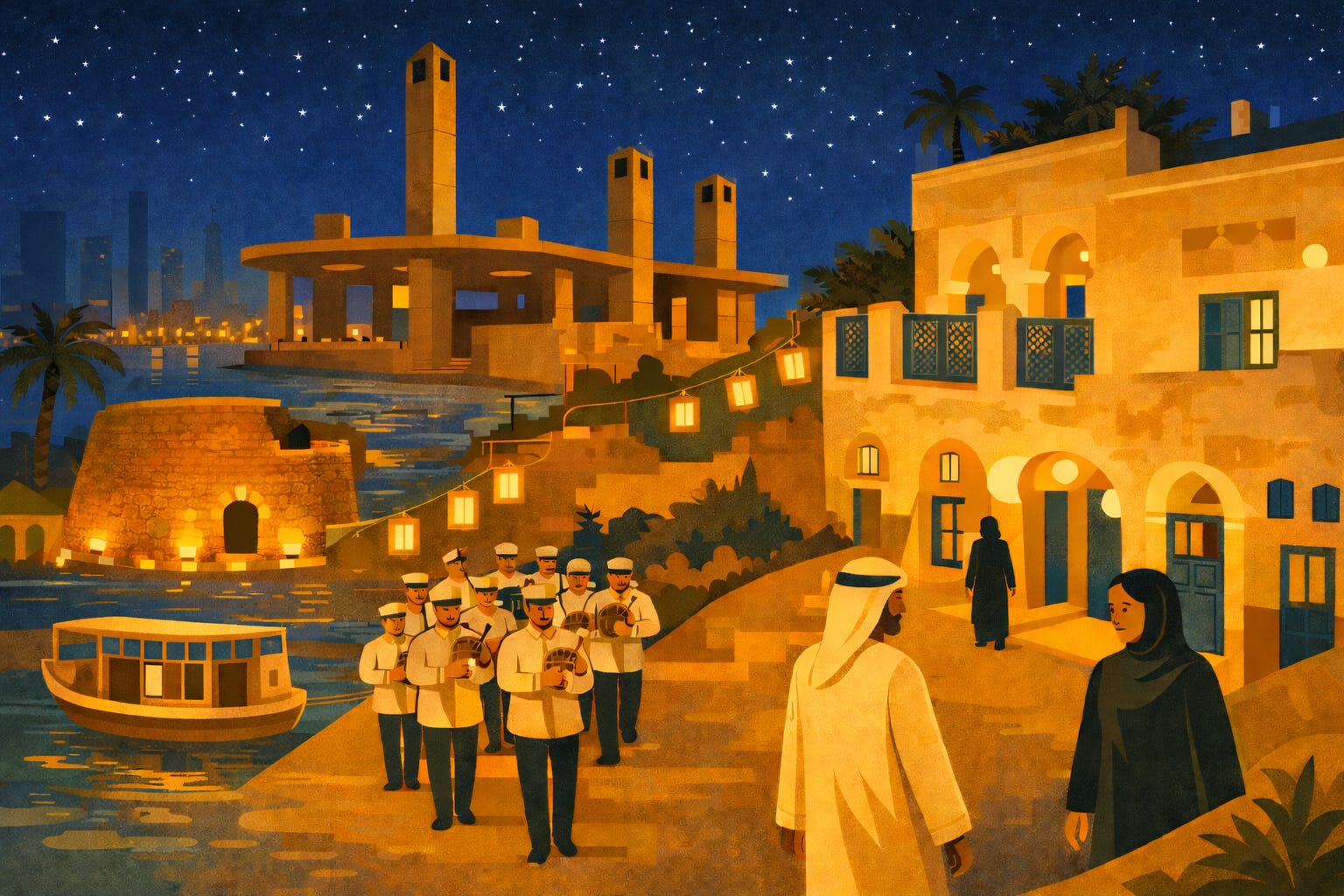
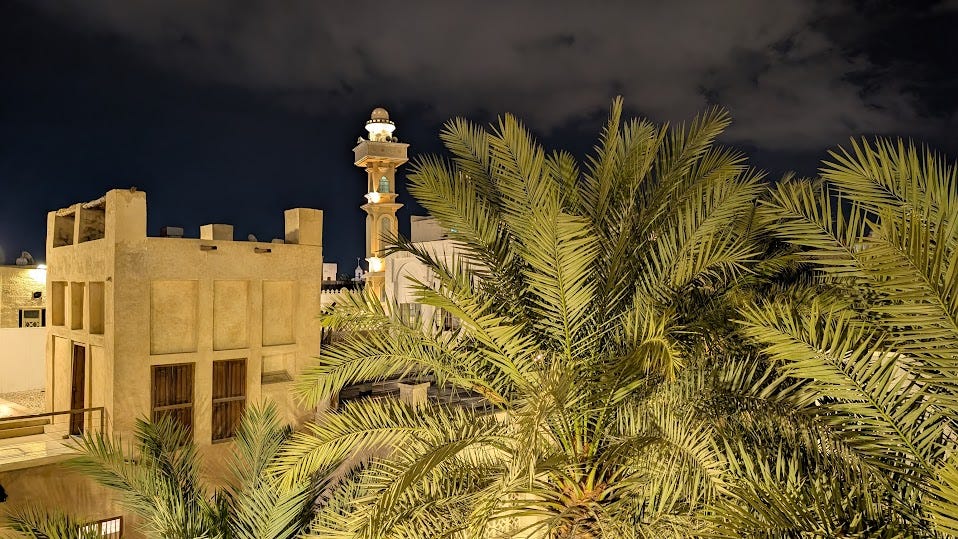
Muharraq Nights began as a simple question: what if the historic fabric of Muharraq could be activated as living infrastructure rather than be treated as a static artifact? The first edition in 2022 [1] was a modest two-weekend celebration, organized along the UNESCO-listed Pearling Path and hosted in various historic houses, streets and courtyards of Muharraq. Instead of importing a generic festival into the city, the idea was to let the city itself become the venue, likening it to an open-air museum. The approach extended cultural programming into existing streets and homes after dark, so that heritage sites became places to stroll through.
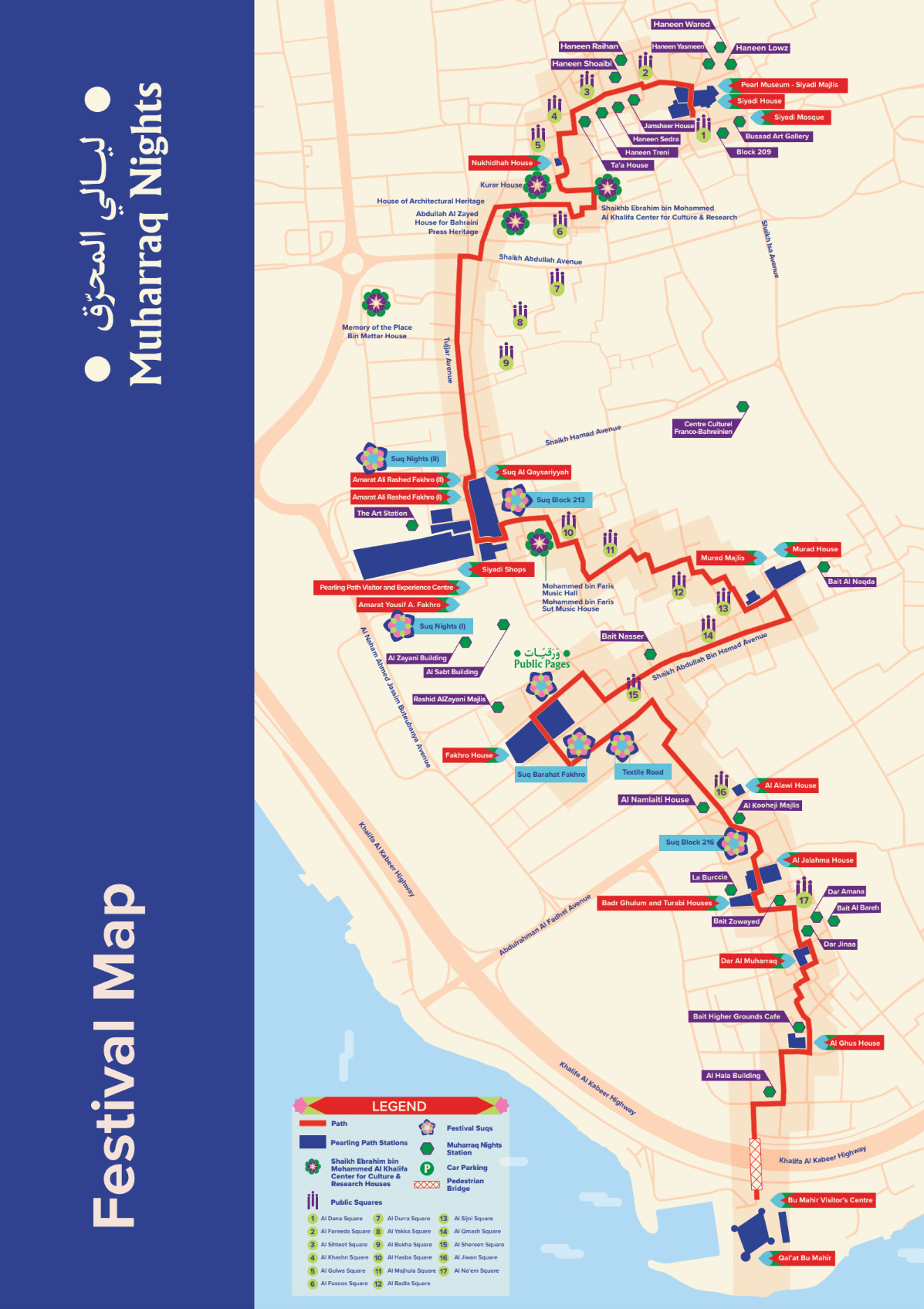
This philosophy treated Muharraq’s old quarter as a dynamic platform, where the event invites organic participation: shopkeepers kept their doors open, artisans demonstrated their crafts, and traditional bands played folk music reminiscent of a bygone era. In short, the city’s own fabric did the heavy lifting, proving that historic neighbourhoods can host their own rhythm rather than merely serve as backdrops.
Who are the main actors involved in making it reality?
Muharraq Nights works because it sits in a productive middle ground between state-led planning and grassroots creativity. It is a partnership of state and non-state actors coordinating closely:
State actors: The Bahrain Authority for Culture and Antiquities (BACA) is the anchor, organizing the festival as part of the national “Celebrate Bahrain” season [2]. Other key government agencies include the Ministry of Works preparing infrastructure, and the Traffic Directorate managing road closures and shuttle routes.
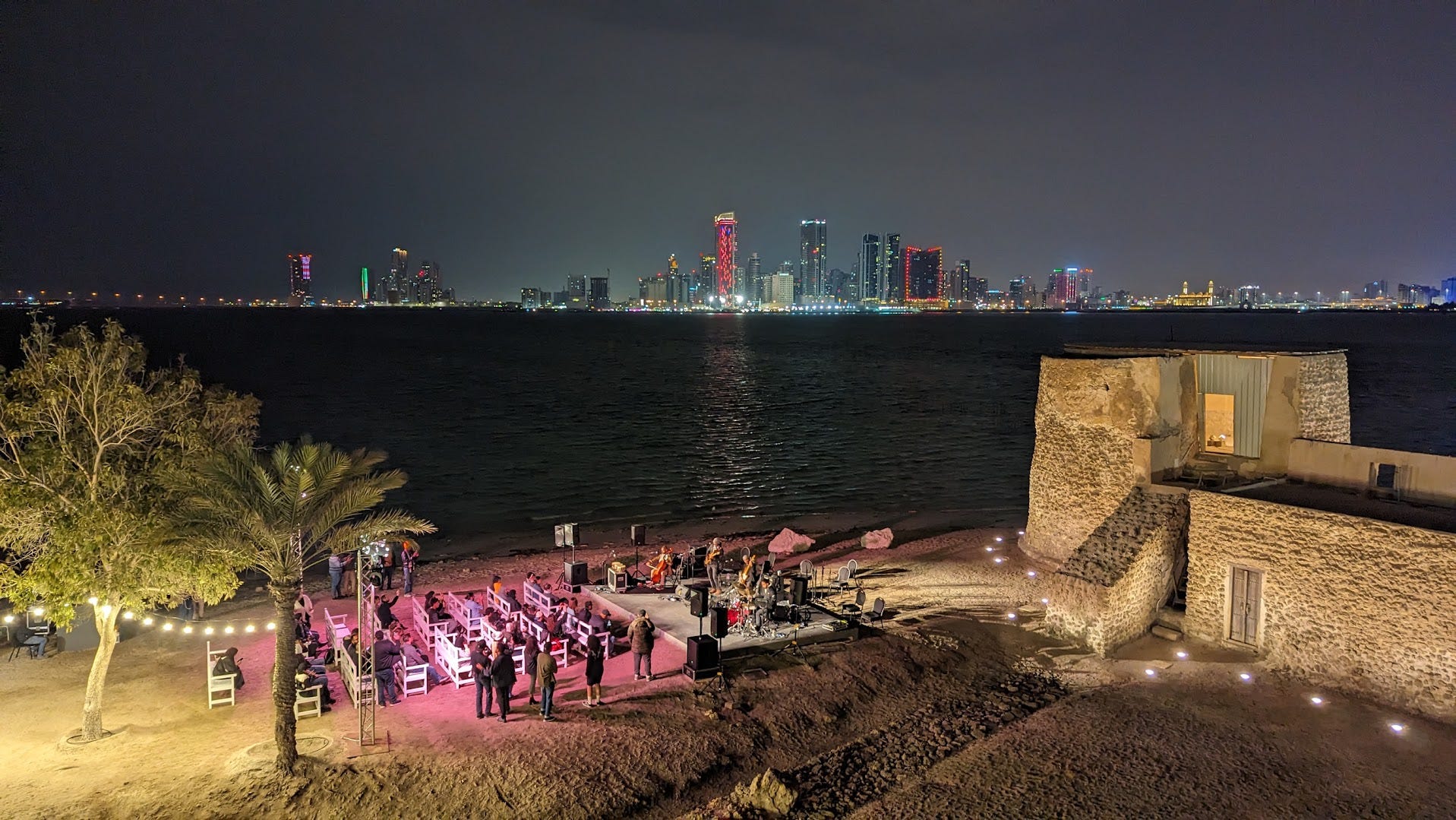
Non-state actors: Much of the festival’s “texture” comes directly from Bahrain’s creative community. Art and design organizations such as Al Riwaq Art Space, Albareh Art Space, Art Concept, and The Art Station have been core partners, transforming heritage houses into galleries and workshop venues. Initiatives such as the Design Majlis expanded following its first edition during Muharraq Nights 2022 and has since hosted discussions on design, architecture, culture, and urbanism. Similarly, Naso Art Journal, a platform dedicated to art in the MENA region, hosted its first in-person events during this edition of the festival, including talks and panel discussions on art, culture, architecture, and urban heritage, enriching regional discourse within a local context. In addition, youth-led initiatives such as Creative Horizons also contributed to the programming through collaborative sharing circles and educational workshops on content creation, illustration, and related fields. Traditional arts were strongly represented, with Bahraini folk music bands and pearl-diving song groups performing Fjiri, Ardha, and other traditional genres at venues such as Dar Al Muharraq and the Mohammed bin Faris Music House. Meanwhile, Qal’at Bu Maher served as a stage for contemporary bands performing against the backdrop of the Manama skyline. Long-established local businesses also played an active role. Halwa shops, wood and gypsum workshops, and neighborhood cafés extended their hours to serve visitors, reinforcing the festival’s integration into everyday life in Muharraq.
Non-exhaustive list of non-state participants, initiatives and organizations
This mix of actors matters, as BACA and other relevant government agencies provide legitimacy, funding, and infrastructure, while the creative community and local businesses provide the cultural content and on-the-ground energy. Neither top-down officials nor informal street participants alone could have achieved the same result.
How did it evolve over the years and where is it now?
Over the past few years, Muharraq Nights has grown from an experiment into a marquee event with a confident identity of its own. The scale and programming of the event have expanded dramatically. By its fourth edition in December 2025, it spanned the entire month and hosted more than 560 activities and over 800 diverse musical performances along the 3.5 km Pearling Path.
The event has seen rapidly growing attendance since its inception. By December 2025, Bahrain’s heritage sites experienced an unprecedented influx, nearly 1 million visitors in December alone, roughly half of whom visited Muharraq’s Pearling Path venues [3]. The 2025 festival itself attracts crowds from across Bahrain and abroad, highlighting how Muharraq Nights has grown into a regional cultural attraction, significantly boosting footfall each winter.
Crucially, as the festival grew, it remained rooted in its authenticity. Local shops and eateries became integral players rather than incidental beneficiaries. Many artisan shops, traditional cafe and restaurant owners actively engaged visitors. The line between an “event” and everyday life blurs, with one outcome being that the stories of Muharraq started to emerge naturally through conversation: elderly residents sitting outside their majlis, tea house, or within their stores, might share memories with curious visitors, and shopkeepers proudly explained their family trades. These unscripted exchanges turned the whole town into a living museum, far beyond what signage or formal tours could achieve.
This year, new public activities were introduced. Public Pages hosted a selection of local and regional publishing houses and bookshops, including Jameel Arts Shop represented by Al Riwaq Art Space, showcasing recent publications in contemporary art, design, architecture, and culture. The Bahrain Authority for Culture and Antiquities also participates with a curated selection of its own publications and exhibition-related titles [4]. The space featured a series of panel discussions and interactive programmes by Creative Horizons, Design Majlis and Naso Art Journal, focused on the exchange of expertise within the fields of art, design, architecture and urbanism.
In addition, Adventures of the Sea offered an immersive pavilion and spatial experience that provided an educational, play-based environment introducing children to Bahrain’s marine life and heritage, demonstrating the city’s adaptability to diverse creative activities.
Several focal points have helped anchor the experience without turning it into a typical stage-managed festival. For instance, pop-up exhibitions and projects have been introduced each year. In 2024, an art initiative by Alriwaq Art Space called “Salmeen Ghaneem” [5] invited 46 artists to create site-specific public art works along the Pearling Path, turning heritage houses into contemporary reflection spaces. These kinds of installations act as pulls for visitors, rewarding curious strollers with intimate cultural moments rather than herding everyone to one big concert.
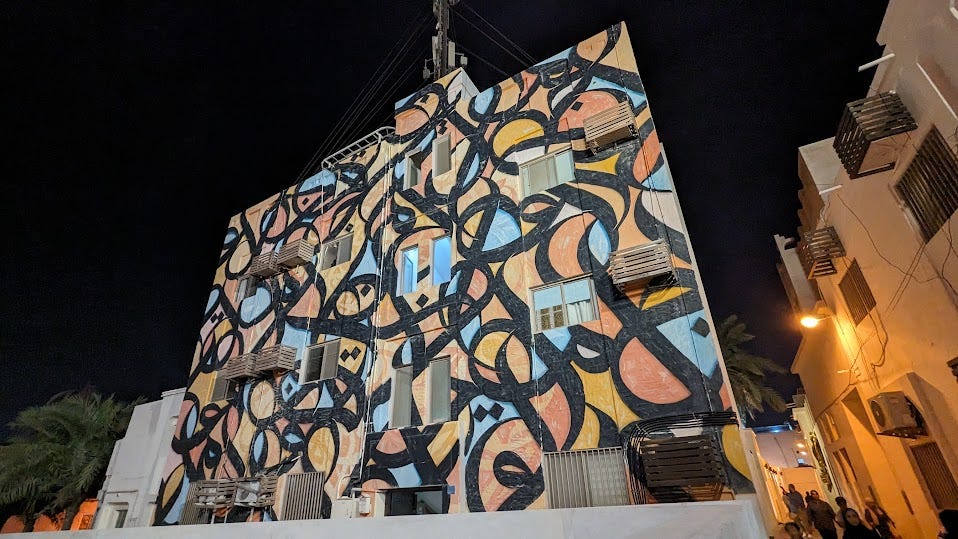
This year, Alriwaq Art Space’s In the Lapse of Tides exhibition was launched alongside the 10th edition of the Nest Festival in November and extended into Muharraq in December. The exhibition’s artistic journey traced a geographical and conceptual journey inspired by tidal movement, beginning with the ebb at Al Riwaq Art Space in Gufool, the journey continued by “following the tide” into Muharraq Nights, where the exhibition reaches its fullest expression.
Cultural houses beyond the Pearling Path buildings have been activated into cultural venues and distinctive food experiences, maintaining an intimate scale that feels more like a community majlis than an official program. Dar Amana, for example, functions as an art community that fosters discussion and cultural activism, while Bread and Paper, Bait Nasser, and Higher Grounds offer creative food experiences that celebrate local flavors.
Mobility and access have been quiet success stories in this evolution too. One of the early challenges was that Muharraq’s old quarters has limited parking and narrow streets, a potential nightmare once larger crowds started coming. Rather than build intrusive infrastructure, organizers devised temporary but clever solutions. A large undeveloped plot of land between two main bridges that connect Manama to Muharraq was designated as Muharraq Nights Parking, with a free shuttle bus ferrying visitors to the Pearling Path every 15 minutes. In addition, the National Museum’s parking lot was used as a park-and-ride hub with boat shuttles across the creek to Qal’at Bu Mahir (linking directly to the Pearling Path). These measures absorbed the parking pressure without overbuilding permanent infrastructure. Inside Muharraq, the festival provided golf buggy carts and managed pedestrian flows to ease movement. The result? Even on peak nights, the small island handled crowds smoothly, proving that solving transport and circulation is part and parcel of enabling authentic urban experiences (it’s hard to enjoy heritage alleyways if they’re jammed with cars, after all.)
What are its plans for the future?
As Muharraq Nights has now solidly grounded itself as a fixture of Bahrain’s annual calendar, the open question is whether it remains a seasonal event or evolves into a year-round platform for the city, and the vision hinted by its leads leans toward the latter. Officials speak of the festival as a “vibrant national platform rooted in identity and closely connected to the community” [6], language that suggests institutionalizing its spirit into Muharraq’s everyday life. Future editions will likely continue expanding content (the 2025 program spanned eight thematic “pillars” from art and design, children’s programs, to food and tours), but also focus on sustaining the gains made so far.
There is clear momentum and support for these ideas, with the future of the event likely focusing on continuity and sustainability. Rather than radically change its character, the goal is to cement what has been built: keep engaging new partners, keep the formula flexible and community-centric, and ensure that each year’s lessons are folded into the fabric of the city. With each cycle, costs can be lowered (through reusing infrastructure and experience), and trust deepens among all those involved. The ultimate aspiration is that Muharraq Nights becomes a permanent feature of the island’s identity, i.e., a system of public-space activation that other initiatives can plug into.
What can the rest of the Gulf learn from Muharraq?
Muharraq Nights may be rooted in Bahrain’s heritage, but its lessons resonate across the region, where many cities are searching for human-scaled, culture-rich urban experiences. A few key takeaways stand out:
Authentic experiences can’t be fabricated by architecture alone: they emerge when existing urban fabric is allowed to perform. The Gulf has invested heavily in stunning museums and heritage villages, but Muharraq’s example shows the power of using real neighbourhoods as the stage. Instead of building a new “old market” from scratch, it activated an actual one. Preserved buildings and alleys came to life once people were encouraged to use them again. The authenticity this created is impossible to replicate with mere construction.
Culture scales better through coordination vs. control: top-down planning alone cannot foster a living culture, and purely informal efforts often lack reach, but a partnership model can marry the two. BACA provided the framework and legitimacy, yet it crucially let community stakeholders lead on content. This “enable, don’t choreograph” approach meant the festival never felt like a highly curated government expo, even though it was officially supported. Other Gulf cities can note the value of empowering local businesses and artists, entrepreneurs, and residents to shape cultural initiatives. The payoff is a richer, serendipitous, and authentic experience.
Public space yields economic and social returns even without direct monetization: Gulf cities often seek immediate financial ROI from events (through ticket sales, malls, etc.), but Muharraq Nights suggests a different calculus. The festival in itself is free to attend, and the streets themselves are the “venue”, yet the economic benefits are tangible. Local eateries and cafes see booming business; home-grown designers and vendors got to test products with new audiences. Perhaps more importantly, residents feel pride seeing their once-quiet neighbourhoods celebrated and rejuvenated with footfall. This kind of social capital is hard to measure, but invaluable. The lesson for the region: a well-curated public space event can circulate money through the local economy and fortify community spirit, even if nobody is charging admission at the gate.
Transport and access are a part of the cultural infrastructure: often, logistical details like parking, traffic and transit are treated as afterthoughts in urban events, but they can make or break the experience. By solving the last-mile problem (via park-and-ride shuttles, water transport, pedestrian friendly planning, and valet parking), it removed some of the barriers that might have kept people away. The authenticity of a street festival quickly evaporates if visitors are circling for parking or are stuck in jams. Gulf cities aiming to rejuvenate old quarters should prioritize mobility solutions that are context-sensitive, and integrate mass-transit to improve efficiency and footfall capture. In Muharraq, rather than bulldozing historic fabric for parking lots or new developments, they found empty land on the periphery and ran shuttles, effectively expanding access without damaging the locale. This approach underscores a broader point of cultural vitality and urban mobility going hand in hand. A heritage district needs thoughtful connections to the wider city (be it through transit, shuttles, or park-walk systems) to truly flourish as a public space.
This annual event exemplifies a growing recognition in Bahrain that the best way to honor urban heritage is to let people experience it firsthand. Although we may be biased as Bahrainis, Muharraq Nights is a great example of re-souqification done right. Other Gulf states, many of which have similar historical districts and winter tourism seasons, can take inspiration from Bahrain to celebrate our shared heritage. The region’s future livability may well depend on how these lessons are applied, nurturing urban spaces that feel ordinary in the best way possible, i.e., full of life, community, and continuity once the fanfare fades.
Sources:
Bahrain Culture - https://culture.gov.bh/en/events/past_events/Name,21102,en.php
Bahrain.com - https://www.bahrain.com/en/muharraq-nights
مليون زائر للمواقع التراثية في البحرين خلال ديسمبر.. ومسار اللؤلؤ يستأثر بنصف الزوّار - Al Ayam Newspaper - https://www.alayam.com/alayam/first/1118899/News.html
BACA: Design programme at Muharraq Nights highlights local and regional creativity
Salmeen Ghaneem - Al Riwaq Art Space https://www.alriwaqartspace.com/blogs/exhibitions/muharraq-nights
Muharraq Nights Festival concludes its fourth edition: BizBahrain - https://www.bizbahrain.com/muharraq-nights-festival-concludes-its-fourth-edition/
“we may be biased as Bahrainis, Muharraq Nights is a great example of re-souqification done” As a Saudi who’s attended more than five times, I completely agree. The whole area felt like one big community, honestly couldn’t get enough of it.