


This article is part of a five-part series on Gulf urbanism: (1) how the car won, (2) how the Gulf’s metro systems have proven their worth, (3) cooling our cities, (4) from mall to street, and (5) housing that fits living in the Gulf. We’ll take a systems lens to explain how decades of choices shaped today’s cities and what can be done to rebalance comfort, mobility, and lively public life.
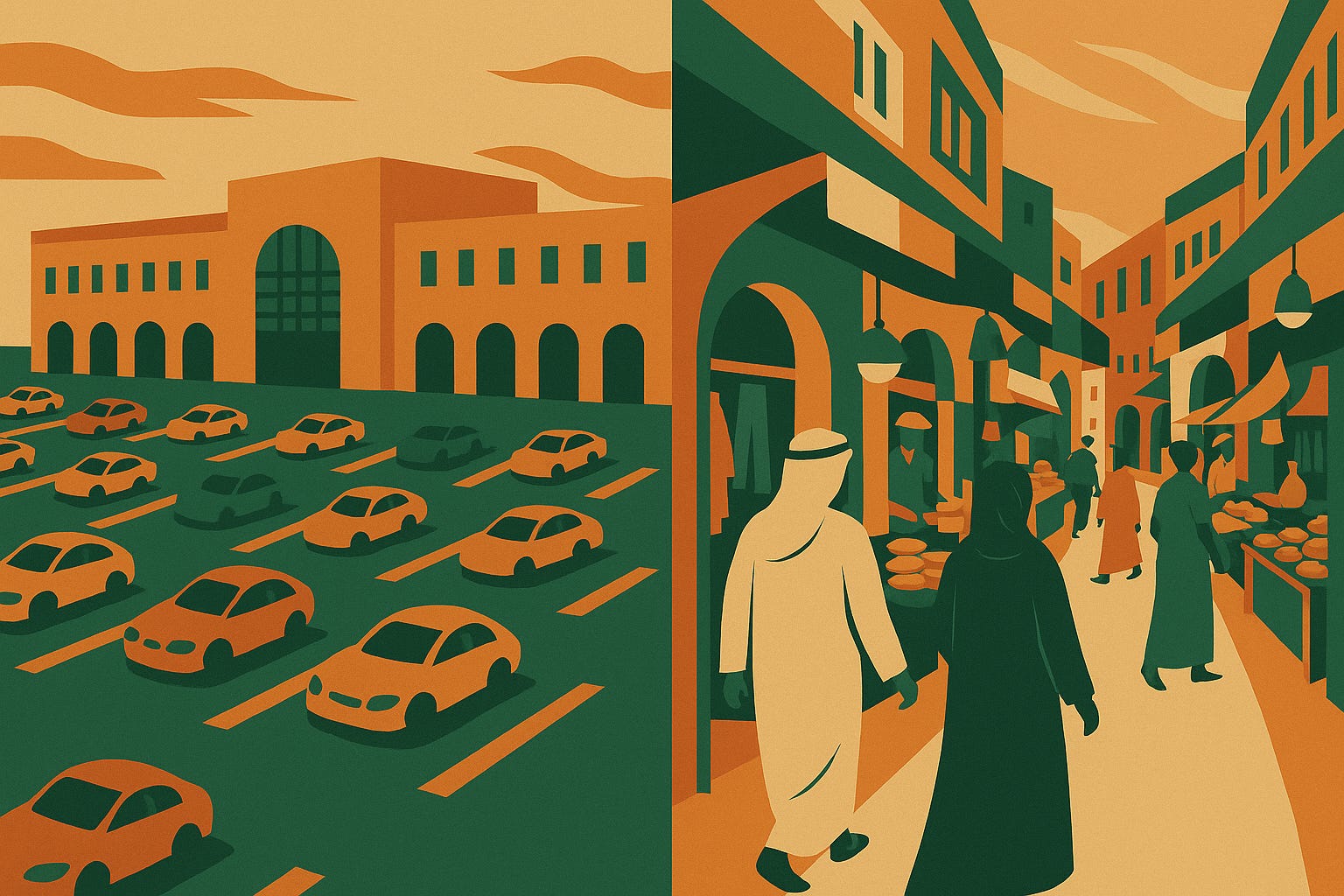
I am begrudgingly writing this from a coffee shop in a mall. Every “public space” nearby is hidden behind valet parking and/or a marble atrium. I’m surrounded by echoing mall-esque music, artificial lighting, and a dozen people carrying shopping bags they didn’t intend to buy. The irony isn’t lost on me: writing about the death of urban life while trapped inside its glossy coffin.
I have a love-hate relationship with these places. On the one hand, a lot of us can attribute our fondest childhood memories to them, and on the other, I also cherish the ‘free-range play’ my siblings and I had with the kids in the neighborhood, from playing football, to cycling around on our bikes. But something happened. The vast air-conditioned complex became the Gulf’s de facto “third place”, filling the void of public parks or plazas during scorching months. Families could walk around indoors, kids could play in arcades (my siblings and I spent countless hours in Seef Mall’s Magic Island), and everything from groceries to luxury watches was under one roof. What we lost was the ‘Freej’ (فريج), where people at least knew each other on a first-name basis, and the Souq (سوق), where spontaneous and serendipitous interactions inherent to a vibrant urban life organically take place. Malls are not communities, and although they’ve given us convenience, they do nothing but suck away urban life from the actual city.
Not even a century ago, Manama and Kuwait City’s souqs and harbors were the beating heart of urban society, “key points of intersection” where different classes, sects, and ethnic groups mingled amid trade. Nelida Fuccaro’s work on pre-oil Bahrain demonstrates Bahrain’s old souqs being ‘polyglot arenas’, where people spoke Arabic, English, Hindi and Farsi given where they came from. In these shaded alleyways, merchants, pearl divers, dockworkers and visitors crossed paths, sharing news and culture in a way no modern mall can replicate.
The seduction of the mall
The rise of Gulf malls made sense at first. Malls promised to replicate the social function of our old urban centers in modern form. They even built fake “souqs” indoors, as in pretty much every major Gulf mall I’ve ever set foot in. Farah Al-Nakib’s work on Kuwait argues that this is an illusion of the city, a sanitized, privately owned environment where you’re welcome so long as you keep spending.
On a lighter note, one is reminded of George Carlin’s riff on American sprawl: “They put the mini-malls in between the major malls, and in between the mini-malls they put the mini-marts…” The Gulf has its own version of this novelty treadmill, with each new mall outdoing the last in size and spectacle (mega-mall, giga-mall, world’s largest mall), until consumer fatigue inevitably sets in. The result is an ever-proliferating mall-scape that is shiny on the surface but extremely fragile at its core.
Why malls are brittle
The mall format is structurally brittle. We’ve imported the American model of overbuilding retail space, and the same death spiral they went through is visible, with the typical lifecycle of a Gulf mall looking something like this:
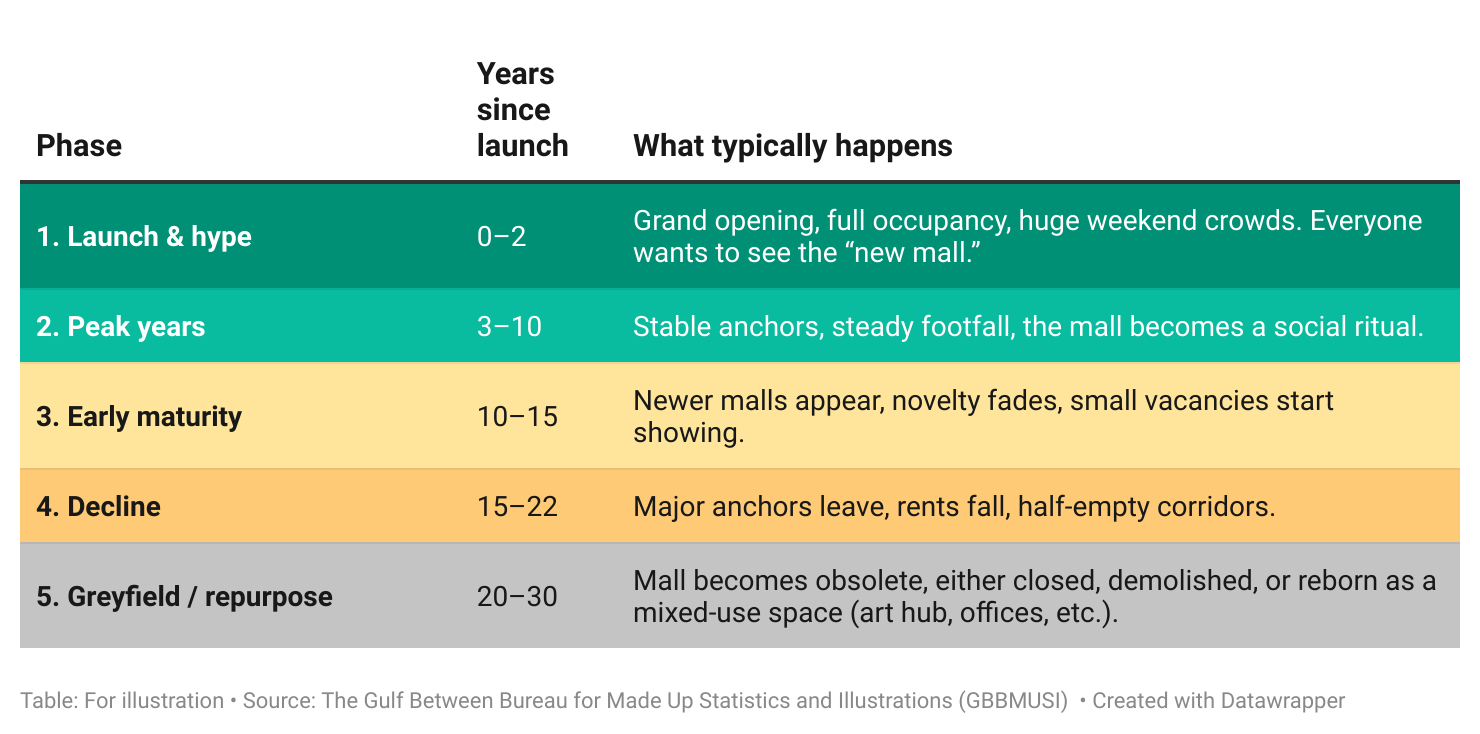
Qatar is a case in point: retail supply more than doubled in five years, but by 2024 about 20% of mall units sat empty (see Cushman & Wakefield’s Q3 2024 report on Qatar’s real estate market). Bahrain’s Marina Mall saw traffic fall, leading one of its flagships, CenterPoint, to close down and move to Bahrain Mall. Riyadh’s early centers like Shola collapsed after newer, flashier complexes siphoned shoppers.
Dubai’s experience illustrates the mid-tier mall squeeze vividly. Beyond the headline-grabbing Dubai Mall (which attracted a mind-boggling 111 Mn visitors in 2024), dozens of smaller malls have come and gone. Al Ghurair Centre, the first modern mall in Dubai, opened in the ‘80s and was the place to shop. It struggles to stay relevant except as a local Deira district center. Lamcy Plaza was once a neighborhood hub but ended as an abandoned shell no one wanted to buy after a fire in 2017.
This creates a powerful feedback loop where mega-malls leverage their footfall to secure exclusive brands, which in turn draws even more visitors, actively starving their mid-tier competitors of both tenants and customers. A handful of mega-malls end up surviving: think Dubai Mall, Mall of the Emirates, Kuwait’s Avenues flagships (that have opened in Bahrain and currently under construction in Riyadh), Qatar’s Villagio etc., while the rest fight for scraps unless they’re a small-mid size mall that serve a specific community. It’s a winner-takes-all dynamic, with overbuilt, underperforming malls littering the landscape as retail gravity consolidates in a few large hubs.
The illusion of community
Malls like to present themselves as “community spaces”. In reality, they are machines for shopping and a poor substitute for genuine urban public space. Every bench, fountain, or ice rink exists to keep you circulating with wallet in hand (or phone, at this point). They externalize costs, with:
Traffic congestion from concentrated weekend trips.
Heat islands from vast parking lots that soak up the sun.
Commercial and urban dead zones after closing hours when surrounding asphalt empties.
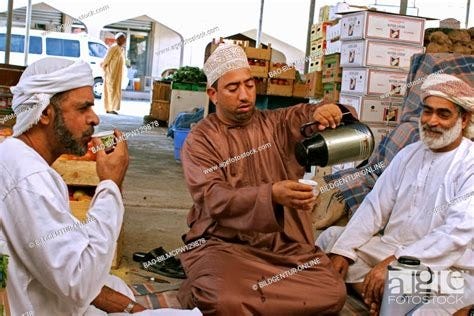
Contrast this with souqs, which were fundamentally generative rather than extractive. As Al-Nakib reminds us, pre-oil Kuwait’s spatial layout and compact urban fabric encouraged openness: dense neighborhoods, shaded alleys, and genuine public squares. Souqs were cultural as much as they were commercial. Even today in Muscat’s Muttrah Souq, or Bahrain’s Manama Souq, it’s a common sight to see elders gather to sip tea and chat in nooks that remain socially alive long after shop doors close.
By comparison, modern planning upended this spontaneity, with zoning and car-centric development (like standalone malls and highways) “eroding the open, cooperative nature of pre-oil society”, breeding insularity and alienation. The result is a cheap imitation of public life that is not truly public at all (I couldn’t help but laugh when I recently witnessed a scheduled and paid for ‘flash mob’ in a mall).
The disconnection problem
Malls are also pods, i.e., isolated capsules of urban activity surrounded by asphalt. They turn their backs to the street. You don’t walk to them, instead you drive, park, consume, and leave. This further feeds our car dependency (think back to part 1 of this series on how the car won), and hollows out the city fabric in between.
Reconnecting the urban fabric requires tackling this disconnection head-on, by integrating mass transit (as covered in part 2 of this series on suggestions for a metro-based intervention) with retail and recreation areas.
Thankfully, transit integration shows another path, where Dubai’s metro stations at MoE, Burjuman, and Dubai Mall can deliver more shoppers than parking lots ever could. Doha’s metro boosted City Center Mall and Msheireb’s redeveloped streets too. Dubai’s City Walk and downtown Dubai Boulevard are blending outdoor retail, shade features and transit access, creating a semi-open district rather than a single building. Where stations open onto shaded sidewalks, footfall spreads naturally into surrounding districts rather than stopping at a single retail box.
Escaping the mall monoculture
What are some practical moves we can take to bring back any semblance of urban life to our cities?
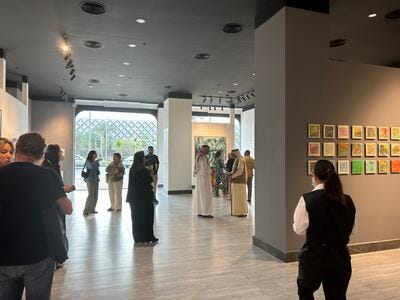
Repurpose dead malls into mixed-use districts, like Riyadh’s Al Mousa Center, reborn as an art hub. Empty or failing mall structures shouldn’t be simply demolished (wasting existing concrete and building materials). Ellen Dunham Jones calls it “Retrofitting Suburbia”, where you take a car-dependent retail site and stitch it back into the urban fabric with new uses.
Mandate street-facing retail in new developments so sidewalks aren’t blank walls, one reason malls proliferated is that zoning and planning often required large parking ratios and separated commercial from residential uses. To counter this, cities can adjust regulations to incentivize small scale, street-facing retail in new developments. You can also give density or height bonuses to projects that incorporate public courtyards or arcades that are open 24/7.
Tie retail projects to transit, where new malls don’t get any approvals without bus or metro integration. Dubai’s Ibn Battuta Mall is a good example. Making transit access non-negotiable would gradually refocus development towards nodes that can be reached without cars. Instead of one mega-mall with 10,000 parking spaces, you might instead get a cluster smaller retail zones along a metro line, each serving different communities
Invest in shading, with trees, fabric canopies, and even solar panel roofs over walkways - (I’ve covered this in part 3 of this series on cooling, so I won’t bore you here)
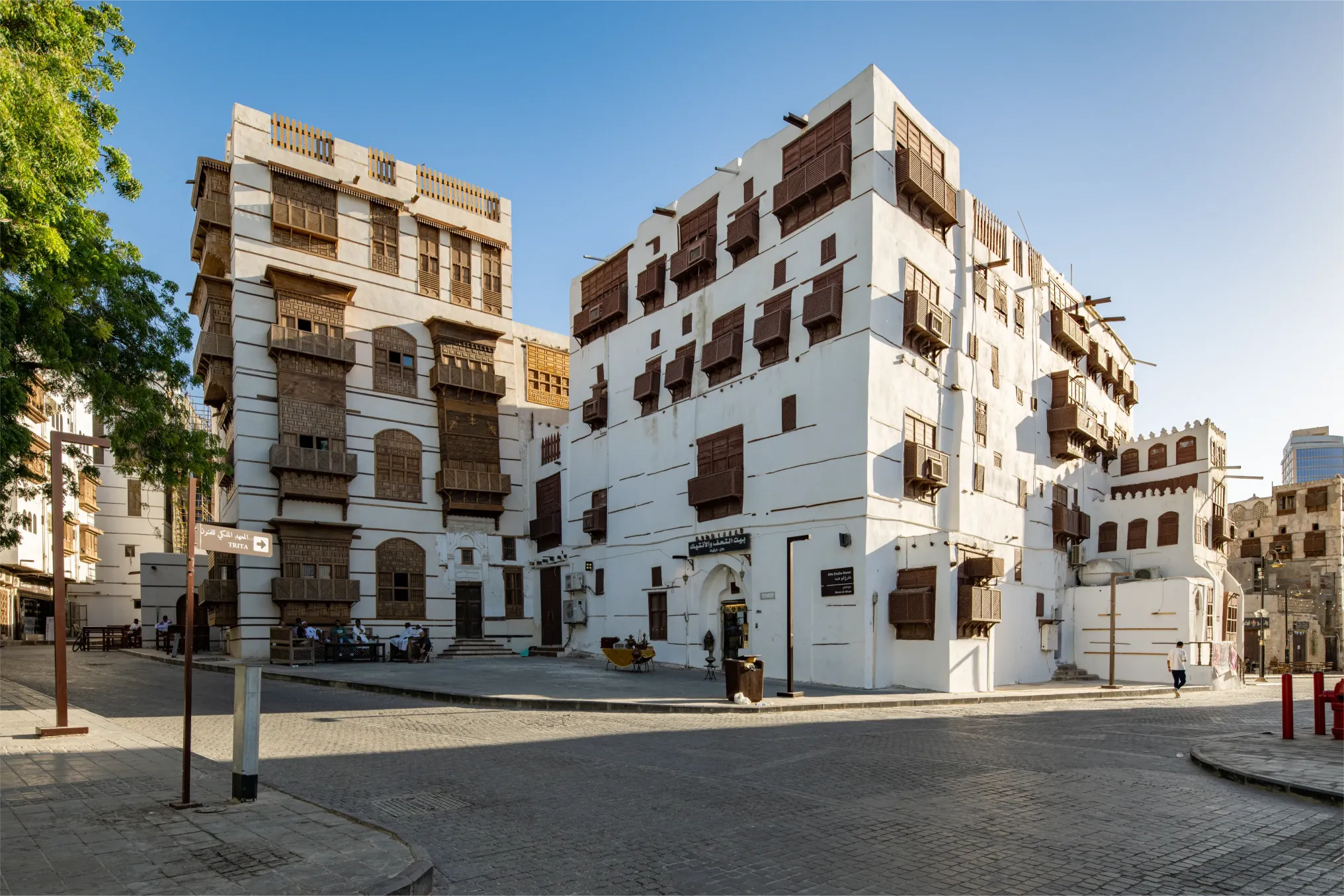
Reviving street life via culture and events with regular night markets, festivals, and food events that pull people into streets and out of malls. Municipalities and tourism boards can program events in historic districts and new public spaces to pull people in. Jeddah’s recently restored Al Balad historical district celebrates its ancient Hejazi architecture
The mall was never the true heir to the souq. It is a fragile, high-maintenance import that offers comfort but drains cities of vitality, an urban monoculture that consumes energy and footfall and gives back very little beyond retail transactions and mindless overconsumption.
Collectively, the Gulf is slowly but surely realizing that the souq and street, by contrast, are time-tested systems that are adaptable, resilient, and genuinely communal. It may seem counter-intuitive, but to build sustainable 21st-century cities in the region, urban planners will need to revive ideas from the 18th and 19th centuries. I’m not advocating for us to abandon malls entirely, but we do need to rebalance. If we want cities that are more than consumption pods, the way forward is clear: rebuild shaded, walkable streets and bazaars. Our ancestors had it figured out, we only need to relearn it, and thankfully, more and more urban initiatives in the region are transitioning towards that.
Such an insightful read! What would be your take on Alserkal Avenue in Dubai? Does it resemble some sort of souqification?